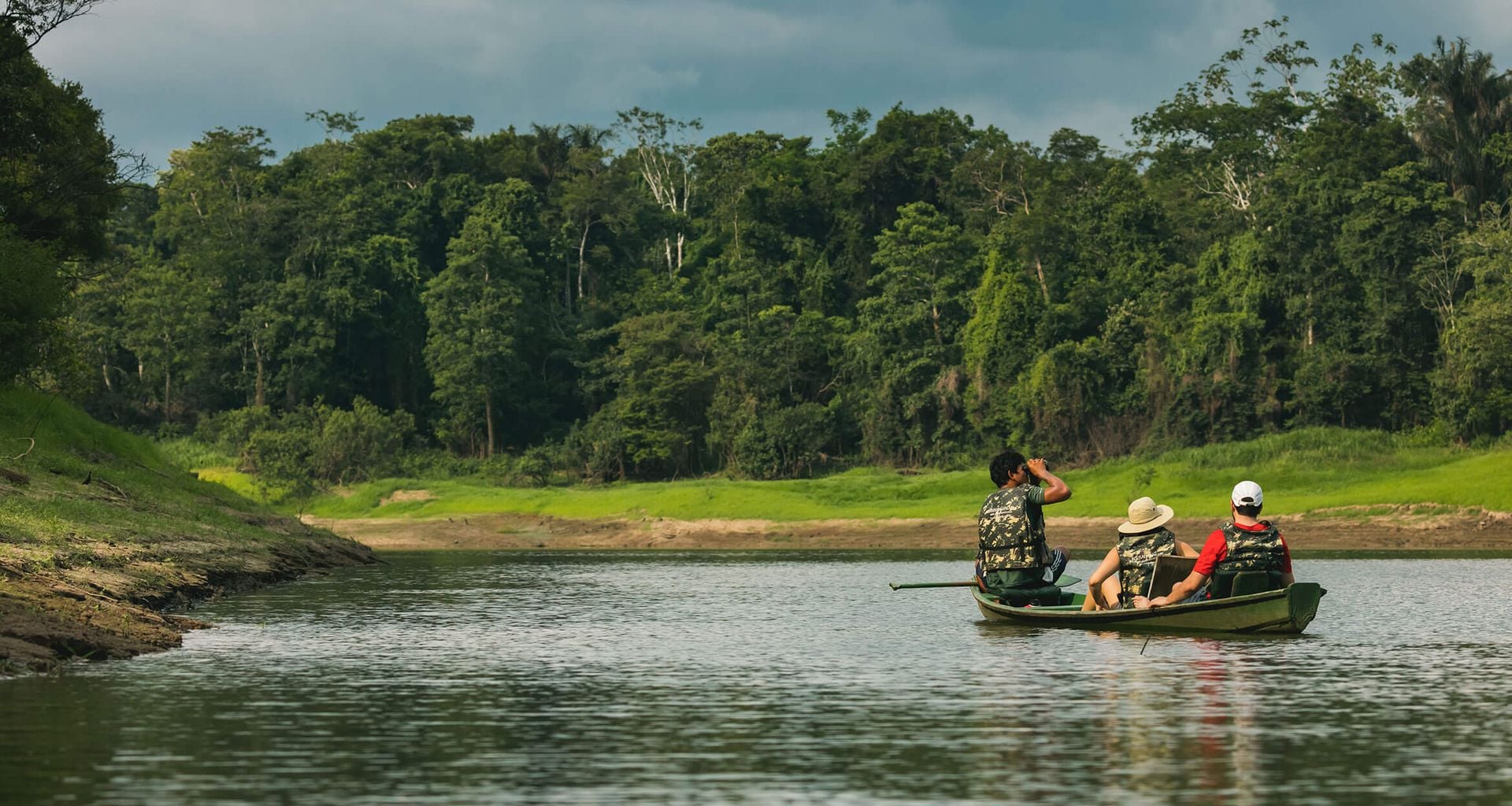
The Amazon is the greatest rainforest on Earth — a living ocean of green spanning nine countries, home to one in ten known species on the planet. It isn’t a single place but a vast region, and where and how you visit it shapes the whole experience. Below are the best things to do in the Amazon, plus the best countries to experience it in, drawn from 30+ years of planning Amazon tours — from riverboat cruises to jungle lodges deep in the canopy.
Whether you dream of pink dolphins, macaw clay licks, or a night alive with jungle sound, the Amazon delivers like nowhere else. Here’s how to make it happen.
We are often asked, "what are the best things to do in the Amazon?" There are plenty of amazing things to do in the Amazon Rainforest, based on your travel interests. There are so many options for travelers visiting the Amazon, from hiking through the jungle to late-night safaris to wildlife spotting and kayaking. One of my favorite things to do is to spot cute capybaras.
-Rebecca Deering
Amazon Travel Expert

The classic way to experience the Amazon is from the water. Comfortable expedition riverboats glide deep into the flooded forest, with daily skiff excursions, guided walks, and wildlife-watching from the deck. It's the most immersive way to reach remote areas — see our Amazon river cruises.

One of the Amazon's most magical encounters: the boto, or pink river dolphin, found only in these waters. In several areas you can watch — and even swim near — these curious, rosy-hued creatures, a highlight for travelers of every age.

The jungle transforms after dark. Guided night excursions by boat and on foot reveal caimans' glowing eyes, tree frogs, nocturnal monkeys, and a soundscape you'll never forget — one of the most thrilling ways to experience the rainforest.

Most of the Amazon's life happens high in the treetops. Suspended canopy walkways and observation towers lift you into that hidden world at dawn — eye-level with toucans, monkeys, and the endless green horizon of the forest roof.

The Amazon is home to hundreds of indigenous peoples. Respectful, community-led visits offer a window into traditional life, medicinal-plant knowledge, and crafts — among the most meaningful and memorable parts of any Amazon journey.

A quintessential Amazon adventure — drop a line into a jungle tributary and try your hand at catching the river's famously toothy piranhas, often cooked up for dinner the same evening. Great fun, and a lesson in the river's food chain.

At dawn, hundreds of brilliantly colored macaws and parrots gather at riverbank clay licks to feed — one of the Amazon's great natural spectacles, and a birdwatcher's dream. The clay licks of the Peruvian and Bolivian Amazon are especially famous.

Fall asleep to the sound of the rainforest at an eco-lodge deep in the jungle. From rustic to genuinely luxurious, Amazon lodges put you in the heart of the wilderness with expert naturalist guides. Explore our Amazon lodge tours.
The Amazon spans several South American countries, and each offers a distinct way in — different wildlife, access points, and styles of travel. Here’s how the main gateways compare.
The largest slice of the Amazon. From Manaus, watch the dark Rio Negro and sandy Rio Solimões flow side by side without mixing at the Meeting of the Waters, then head out to lodges and riverboats. The base for our Brazil Amazon tours.

Peru offers two gateways: remote Iquitos, reached only by air or river and the launch point for luxury cruises, and Puerto Maldonado near the wildlife-rich Tambopata reserve. Easy to combine with Machu Picchu. See our Peru Amazon tours.

Compact and astonishingly biodiverse, Ecuador's Oriente — the Yasuní and Cuyabeno reserves — pairs perfectly with the Andes and Galápagos, offering excellent lodges just a short flight from Quito.
Bolivia's Madidi National Park and the nearby pampas wetlands, reached via Rurrenabaque, deliver some of the continent's best wildlife density — pink dolphins, caimans, and capybaras — at a fraction of the crowds and cost.
In Colombia's far south, the river town of Leticia sits where Colombia, Peru, and Brazil meet — gateway to the Amacayacu National Park and a less-traveled, culturally rich corner of the rainforest.
Every Amazon trip begins with a flight to a gateway city, then onward by small plane, riverboat, or road to your lodge or ship. The main gateways are Manaus (Brazil), Iquitos and Puerto Maldonado (Peru), Coca (Ecuador), Rurrenabaque (Bolivia), and Leticia (Colombia). From there it’s the water and the trails. Because logistics are specialized and the best lodges book up, the Amazon is a region to plan with an expert. We match the destination, lodge or cruise, and season to what you want to see. See our Amazon adventure tours.
The best time to visit the Amazon depends on what you want. The high-water season (roughly December–May) floods the forest, ideal for boat exploration deep among the trees and canoe access to hidden channels. The low-water season (June–November) exposes riverbanks and beaches, better for jungle hikes, fishing, and spotting wildlife concentrated around shrinking water. Both are rewarding — it’s a trade-off, not a bad-season problem.
Yes, with the right preparation. Traveling with an established lodge or cruise operator and experienced guides, as we arrange, keeps you safe in a genuinely wild environment. The real considerations are health-related — yellow fever vaccination and malaria precautions are recommended for most Amazon regions, so consult a travel clinic before you go. See our Amazon safety guide.
The Amazon is known for being the largest and most biodiverse rainforest on Earth — the mighty Amazon River, pink dolphins, jaguars, macaws, and thousands of species found nowhere else, alongside the indigenous cultures who have called it home for millennia. It is the ultimate wilderness experience in South America.
It depends on your trip. Brazil (Manaus) has the biggest rivers and classic cruises; Peru (Iquitos or Puerto Maldonado) offers superb lodges and combines with Machu Picchu; Ecuador pairs with the Andes and Galápagos; Bolivia (Rurrenabaque) is the best value with excellent wildlife; and Colombia (Leticia) is the road less traveled. We'll match the gateway to your wider itinerary.
Plan a minimum of 3–4 days at a lodge or on a cruise — enough to reach deeper, wilder areas and see a real range of wildlife. Day trips barely scratch the surface. The Amazon slots naturally into a larger trip, adding a few days to a Peru, Brazil, or Ecuador itinerary. Our planners build it in.
Both are excellent. A cruise covers more ground, reaching remote areas with comfort and changing scenery daily — ideal for first-timers and the Peruvian and Brazilian Amazon. A lodge offers a deeper sense of place, more time on the trails, and often better value. We'll recommend based on your region, budget, and travel style.
As a benchmark from our own 40+ Amazon itineraries, trips start around $1,000 per person, with most lodge and cruise programs running roughly $300–450 per person per day given the remote logistics, guiding, and all-inclusive nature. Luxury riverboats and the most remote lodges sit at the higher end; Bolivia is the best value.
Expect pink and grey river dolphins, monkeys, caimans, sloths, macaws and hundreds of other birds, and — with patience and luck — capybaras, giant otters, and even jaguars. The Amazon has more species than anywhere on Earth, and a good naturalist guide is what turns a wall of green into an unforgettable safari.

Our favorite Amazon tour ideas featuring the best destinations & activities designed to inspire…
Get your FREE Amazon Guide Now!

