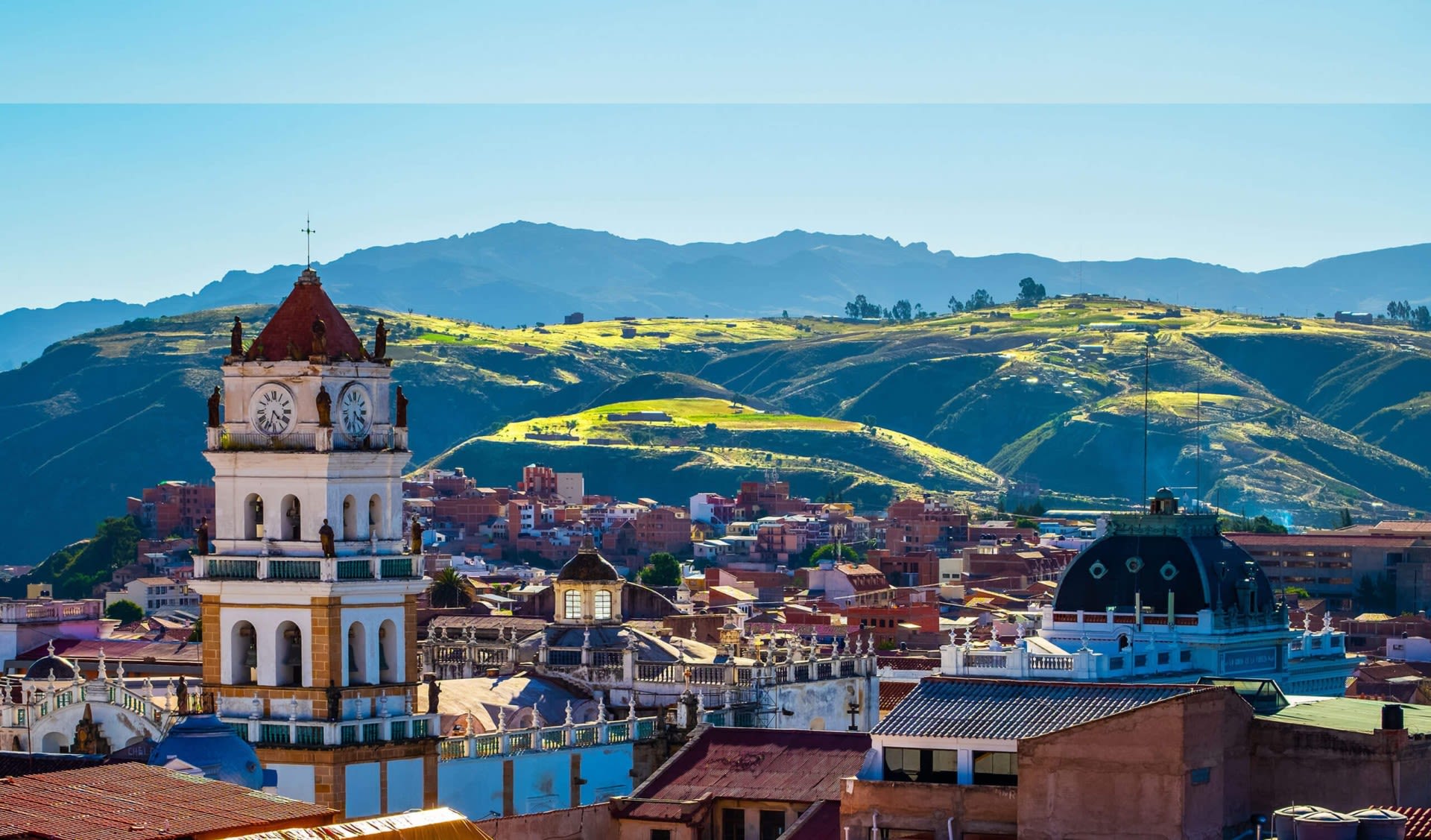
Raw, high, and utterly original, Bolivia is South America’s most authentic adventure. It’s home to the surreal Uyuni salt flats, the world’s highest capital, ancient Andean cultures, and Amazon rainforest — all at a fraction of the cost and crowds of its neighbors. Below are the 9 experiences and 6 places our team rates highest after 30+ years of planning Bolivia tours, from the Salar de Uyuni to Lake Titicaca and colonial Sucre.
A word to the wise: much of Bolivia sits above 3,500m, so itineraries need to be built around altitude. Get that right, and few countries reward you more richly.
Updated for the 2026-2027 Bolivia travel season.
Bolivia is one of the untouched destinations in South America. Its high-altitude landscapes will make you feel like you are in a new world. My recommendation for things to do in Bolivia, besides admiring the landscapes, would be to spend time with the locals and gain a better understanding of their way of life. You can join their sunset rituals and have a better connection with the locals as well as with nature.
-Sinan Baysan
Bolivia Travel Expert

The world's largest salt flat is Bolivia's unmissable icon: 10,000 sq km of blinding white hexagons that become a giant mirror reflecting the sky after rain. A multi-day 4x4 journey adds cactus-studded islands, flamingo lagoons, and desert nights. Explore our Salar de Uyuni tours.

The world's highest capital sprawls up a dramatic canyon, and the best way to take it in is the Mi Teleférico — the planet's largest urban cable-car network, gliding over the rooftops with the snow-capped Illimani beyond. Add the witches' market and the lunar Valle de la Luna. See La Paz tours.

South of Uyuni, the remote Eduardo Avaroa reserve is a surreal highland world: the blood-red Laguna Colorada dotted with flamingos, the emerald Laguna Verde beneath a volcano, steaming geysers, and desert hot springs — the wild grand finale of the classic salt-flats circuit.

The world's highest navigable lake shimmers a deep blue at 3,800m. From the pilgrim town of Copacabana, boats cross to the Isla del Sol — the mythical birthplace of the Inca — where you can walk ancient trails between ruins with the Andes on the horizon.

Once one of the richest cities on Earth, UNESCO-listed Potosí sits at a dizzying 4,000m beneath Cerro Rico, the mountain of silver that bankrolled the Spanish empire. Sobering guided visits into the still-working cooperative mines are among South America's most powerful travel experiences. See Potosí tours.

Bolivia's whitewashed constitutional capital is its most beautiful city — a UNESCO World Heritage centre of colonial churches and mansions, a mild climate, and a relaxed pace. It's the birthplace of Bolivian independence and a lovely spot to slow down. Explore Sucre tours.

Near Lake Titicaca stand the enigmatic ruins of Tiwanaku, a monumental pre-Inca civilization that flourished over a thousand years ago — the Gateway of the Sun, carved monoliths, and stepped pyramids that still puzzle archaeologists. See Tiwanaku tours.

Drop from the Andes into the steamy lowlands and Bolivia opens into pristine rainforest and the wildlife-packed pampas around Rurrenabaque. River trips here deliver some of the continent's best sightings — pink river dolphins, caimans, capybaras, and monkeys — with a fraction of the crowds of Peru or Brazil.

For the adventurous, Bolivia's Andes deliver: mountain biking the legendary "Death Road" from the high passes down into steamy Yungas valleys, trekking Inca trails, or gazing up at 6,000m peaks like Huayna Potosí. High-altitude thrills few countries can match.
From the world’s largest salt flat to colonial cities and Andean markets, these are the landmarks that define a Bolivia trip.
The world's largest salt flat — a blinding white expanse that turns into a perfect mirror after rain. Bolivia's defining image and the centerpiece of most itineraries, ringed by cactus islands and flamingo lagoons.

The Laguna Colorada (red, flamingo-filled) and Laguna Verde (emerald green) sit amid geysers and volcanoes in Bolivia's remote southwest — an otherworldly high-altitude landscape at the end of the salt-flats route.

Just outside La Paz, wind and rain have eroded a hillside into a maze of pale, spiky spires — the "Moon Valley," an easy and surreal half-day escape from the capital.

In Sucre stands the building where Bolivia declared independence in 1825 — the nation's most important historic site, and the heart of its loveliest colonial city.

The "rich mountain" that funded an empire looms over Potosí, still worked by cooperative miners today. A visit is a sobering, unforgettable window into the human cost of Bolivia's silver history.

Near Sucre, the Sunday market at Tarabuco is one of the Andes' most colorful — indigenous communities in traditional dress trading textiles and crafts, a vivid immersion in living Bolivian culture.

La Paz and Santa Cruz are the main air gateways, with domestic flights linking them to Sucre, Uyuni, and the Amazon town of Rurrenabaque — a huge time-saver given the mountainous terrain. The classic salt-flats circuit is done by 4×4 over several days. The single most important planning factor is altitude: La Paz sits at 3,600m and Potosí at 4,000m, so itineraries should build in acclimatization — many travelers start lower, or combine Bolivia with time in the Peruvian Andes first. We handle the flights, 4×4 logistics, and pacing. See our custom Bolivia trips.
Bolivian cuisine is hearty highland fare: salteñas (juicy baked empanadas), silpancho, and countless varieties of potato and quinoa native to the Andes. In the lowlands the food turns tropical, and singani — Bolivia’s aromatic grape spirit — is the national drink, best sampled in a chuflay.
Yes, for prepared travelers. Bolivia is welcoming and the main tourist regions are well accustomed to visitors; La Paz calls for ordinary city sense. The genuine health consideration here is altitude, not crime — acclimatize properly and take it easy on arrival. Occasional political demonstrations can affect transport, which is where a local operator helps. See our Bolivia safety guide.
The best time to visit Bolivia is the dry season, roughly May to October, with clear skies ideal for the Altiplano, Uyuni, and the Andes. For the famous mirror effect on the salt flats, visit in the wet season (December to April), when a thin layer of water turns the salar into a giant reflection — a trade-off against rougher road conditions.
Bolivia is known for the Salar de Uyuni, the sky-high city of La Paz, Lake Titicaca, its strong indigenous Aymara and Quechua cultures, the silver of Potosí, and being one of South America’s most affordable, adventurous, and authentic destinations. For a closer look, see our guide to what Bolivia is famous for.
Plan 7–10 days for the highlights — La Paz, Lake Titicaca, the Uyuni salt flats, and Sucre or Potosí — allowing time to acclimatize to the altitude. Add days for the Amazon or a longer salt-flats-and-lagoons circuit. Many travelers combine Bolivia with Peru, since the two share Lake Titicaca. Our planners pace it around the altitude.
A common route: Days 1–2 La Paz and Tiwanaku (easing into the altitude); Days 3–4 Lake Titicaca and the Isla del Sol; Days 5–7 the Uyuni salt flats and colored lagoons by 4x4; Days 8–10 colonial Sucre and Potosí. Many arrive overland from Peru via Lake Titicaca.
Bolivia is one of South America's most affordable countries day-to-day. Because trips here are specialized — 4x4 salt-flat circuits, domestic flights, guides — our tailored Bolivia itineraries generally start around $1,500 per person and vary with length, hotel tier, and how remote you go. It remains excellent value for the experiences on offer.
Carefully — it's the single biggest planning factor. La Paz is at 3,600m and Potosí at 4,000m, high enough to affect most visitors. We build in acclimatization time, often starting lower or combining with the Peruvian Andes first, keep the first days gentle, and advise on hydration and coca tea. Anyone with heart or lung conditions should consult a doctor before travel.
It depends on the effect you want. The dry season (May–October) gives firm, easy-to-cross salt and reliable weather. The wet season (roughly December–April) brings the famous mirror — a thin sheet of water reflecting the sky — but rougher roads and some areas inaccessible. Both are spectacular; we'll advise based on your dates.
Yes, for travelers who come prepared. The main tourist regions are welcoming and used to visitors, and La Paz calls for ordinary city sense. The chief consideration is altitude rather than crime. Occasional demonstrations can disrupt transport, which is exactly where a local operator earns its keep. See our Bolivia safety guide.

Our favorite Bolivia tour ideas featuring the best destinations & activities designed to inspire…
Get your FREE Bolivia Guide Now!

