
Short answer: Patagonia sits at the southern tip of South America, shared between Argentina and Chile. It stretches from roughly the Colorado River in the north down to Tierra del Fuego and Cape Horn at the very bottom of the continent — somewhere between 670,000 and over a million square kilometers of windswept steppe, glaciers, fjords, and jagged mountains, split down the middle by the Andes. The exact figure depends on where you draw the northern line, which is part of what makes “where is Patagonia?” a surprisingly slippery question.
Alright — so we already know Patagonia is a wild, beautiful wilderness paradise somewhere down at the bottom of the world. That’s a good start! (If you’re curious what makes it special, our guide to what Patagonia is famous for has you covered.) But one question still trips people up: where is Patagonia, exactly? Let’s simplify it for you.
Patagonia is in South America — the southern end of it, to be precise. It’s the tapering tail of the continent, the last great wilderness before the Southern Ocean and, beyond that, Antarctica.
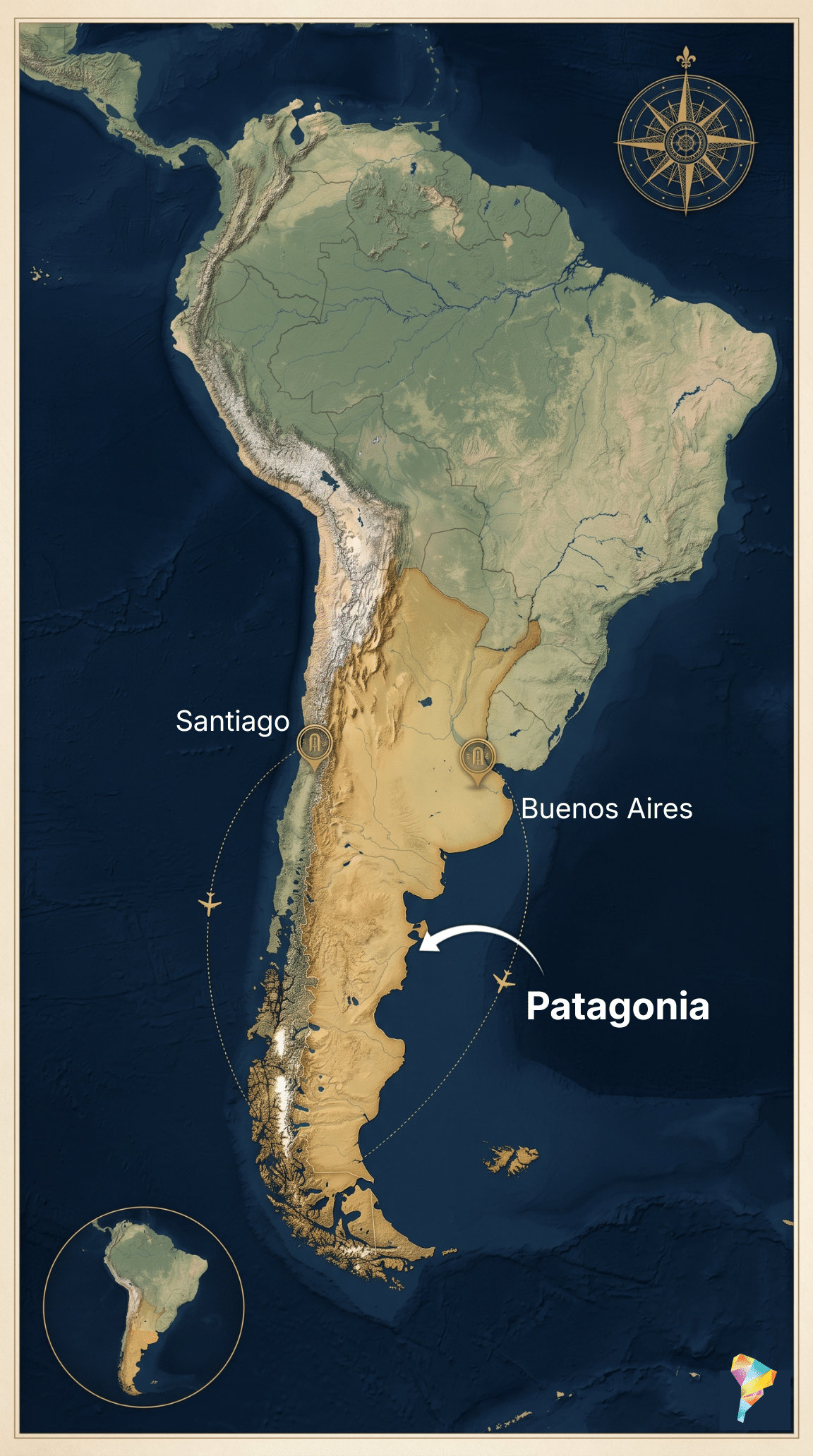
Here’s the twist that makes “where is Patagonia?” tricky: it isn’t one country’s land at all. Patagonia is shared by two — Argentina and Chile. As the map shows, it blankets the entire southern third of South America, with the Andes running down the middle as the natural border between the Chilean side to the west and the Argentine side to the east. So when someone asks which country Patagonia is in, the honest answer is “both” — and the two halves feel wonderfully different, as we’ll see.
If you want firm lines on a map, you won’t quite get them — Patagonia is a region, not a country, so its edges are drawn by convention rather than by any border post. Most geographers mark the northern limit at the Colorado River (and the Barrancas River that feeds it), which cuts across Argentina around 39° south. From there the region runs all the way down to Tierra del Fuego, the wind-scoured archipelago at the continent’s tip, and out to Cape Horn — the last scrap of land before the Drake Passage and Antarctica. The Strait of Magellan threads between the mainland and Tierra del Fuego.
Add it all up and Patagonia covers anywhere from about 670,000 to over a million square kilometers, depending on whose boundary you use — larger than France, and by the broadest definition larger than France and Germany combined. That sheer scale is exactly why it refuses to sit still inside one tidy answer.
The name is almost as colorful as the landscape. It dates to 1520, when Ferdinand Magellan’s expedition became the first Europeans to reach these shores and met the Tehuelche people — who, at well over six feet, towered over the average European of the day. Magellan’s crew called them Patagones. Exactly why is still debated: one theory traces it to pata (“foot”), giving the romantic “land of the big feet”; another points to Patagón, a giant from a popular 16th-century Spanish romance the sailors would have known. Either way, the name has carried its “land of giants” aura ever since — and one look at the mountains and glaciers tells you why it stuck.
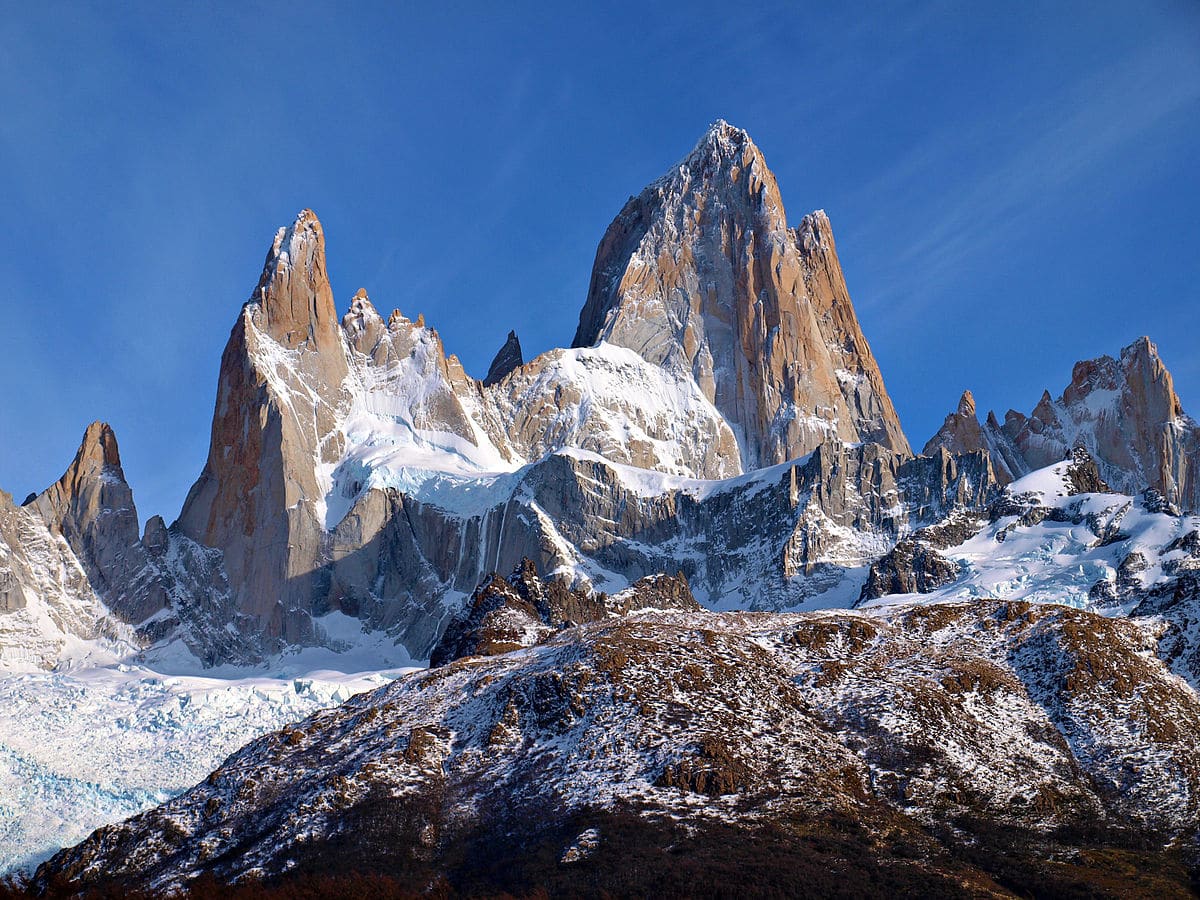
East of the Andes, Argentine Patagonia unfolds as wide, windswept steppe and plains, spanning the provinces of Neuquén, Río Negro, Chubut, Santa Cruz, and Tierra del Fuego. It’s a land of headline names. Bariloche anchors the lake-and-forest scenery of the north; El Calafate is the gateway to the thundering Perito Moreno Glacier; and El Chaltén, Argentina’s trekking capital, sits right beneath the granite spires of Mount Fitz Roy (pictured above). On the Atlantic coast, the Península Valdés draws southern right whales, penguins, and sea lions. And at the very bottom lies Ushuaia, long billed as the world’s southernmost city — a title now also claimed by tiny Puerto Williams just across the Beagle Channel in Chile. Either way, Ushuaia remains the main jumping-off point for Tierra del Fuego and Antarctic cruises.
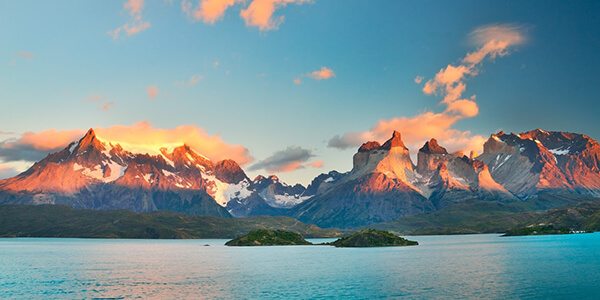
West of the Andes, Chilean Patagonia is a different world entirely — a labyrinth of fjords, islands, temperate rainforest, and glaciers reaching across the Aysén and Magallanes regions. At its heart sits the Southern Patagonian Ice Field, the largest mass of ice in the Southern Hemisphere outside Antarctica and the third-largest expanse of continental ice on Earth, after only Antarctica and Greenland. It feeds dozens of glaciers, including the famous Grey Glacier inside Torres del Paine National Park, whose three sheer granite towers are one of the most iconic sights in all of South America. Frontier towns like Puerto Natales and Punta Arenas serve as the gateways, threaded together by the rugged, road-trip-worthy Carretera Austral.
Because Patagonia is so vast, there’s no single front door. Most travelers fly first into Buenos Aires or Santiago, then connect to a regional gateway — El Calafate for the glaciers, Bariloche for the Lake District, Ushuaia for Tierra del Fuego, or Punta Arenas for Chilean Patagonia and Torres del Paine. We’ve mapped out the routes, airports, and timing in detail in our full guide to how to get to Patagonia.
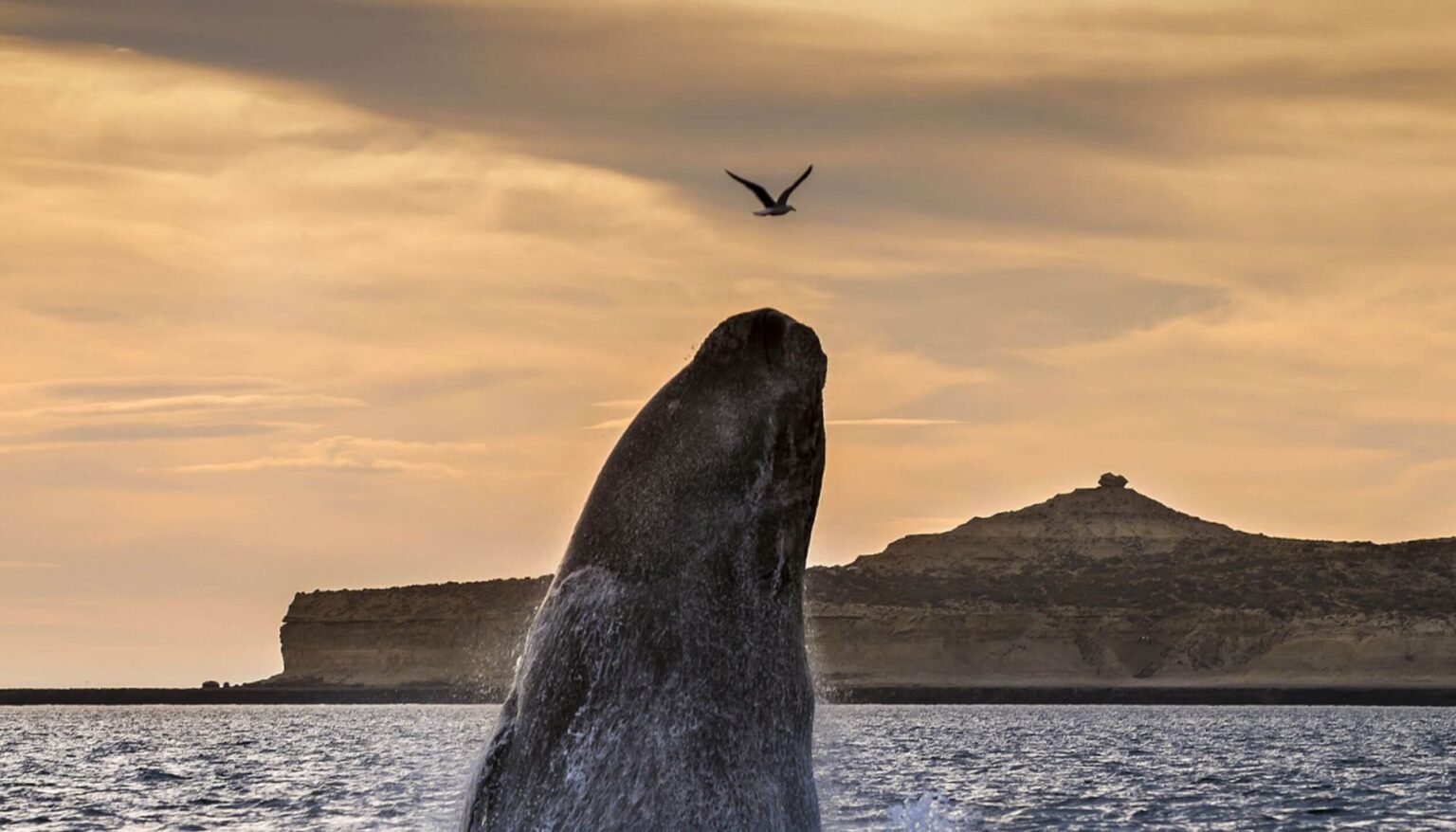
Patagonia’s weather is the stuff of legend: cold, relentlessly windy, and capable of serving up all four seasons in a single afternoon. The Andes wring the moisture out of Pacific storms, so the Chilean west is green, wet, and forested while the Argentine east lies in a dry rain shadow of golden steppe. That raw, untamed climate is exactly what keeps the region so wild — home to guanacos, Andean condors, pumas, Magellanic penguins, sea lions, and the southern right whales that calve off the coast. The best time to visit is the austral spring through autumn, roughly October to April, when the days are long, the trails are open, and the wildlife is at its most active. Peak summer (December to February) is the warmest and busiest; the shoulder months trade a little warmth for far thinner crowds.
Patagonia is at the southern end of South America, in both Argentina and Chile — a huge region of plateaus, glaciers, plains, foothills, wild animals, towering mountains, whales, and penguins, with everything from rustic mountain lodges to luxury, five-star eco-resorts. Now that we’ve pinned down where Patagonia is, the only questions left are how long you’ll stay — and what you’ll do when you get there!



