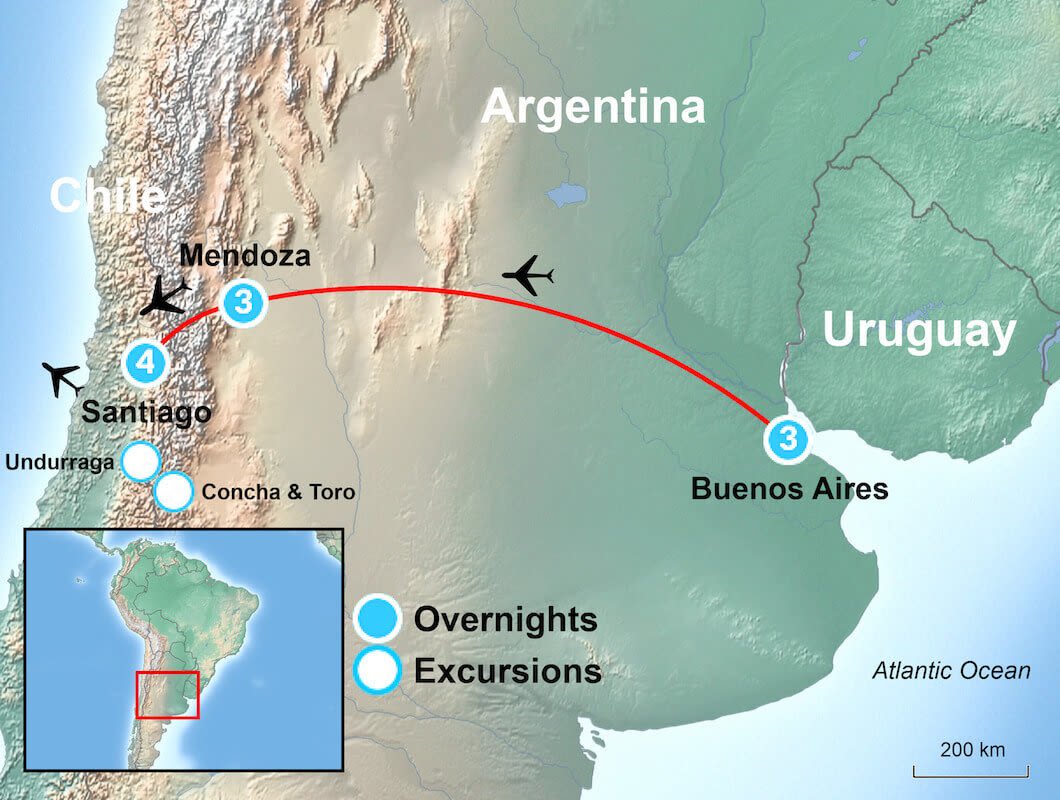
*Example by 4 travelers in 4★ accommodation, low season. Flights priced separately. Get a quote for 1 to 99+ below
The first three days are about the table in Buenos Aires. One night it is an asado in Palermo Soho, with an Argentine host to answer questions; the next day you cook, with locro and milanesa a la napolitana on the menu, and eat what you made. First you watch it done properly, then you try it yourself.
Mendoza is left open on purpose. You get two free days in wine country for horseback riding through the vineyards, tastings or plain rest, and nothing is scheduled. Then you cross the Andes to Santiago, by short flight or, in summer, by bus. There the food is in the markets and on foot, and the one organized wine day goes to the Maipo Valley and Concha y Toro.
Buenos Aires gets three nights, Mendoza three and Santiago four, moving east to west. The meals set the pace, and the wine keeps them company.
Your guide meets you on arrival in Buenos Aires and transfers you to the hotel. Settle in, because the first evening is all about dinner: a tango show with a full meal, wine and live music. Professional dancers perform in the city where the tango was born, and you eat while they do. It is a gentle way to start, with nothing to navigate after a long flight.
The day begins with Buenos Aires itself: the Obelisk, 9 de Julio Avenue, the Colón Theater, Plaza de Mayo and Plaza San Martín. The tango neighborhoods of La Boca, Monserrat and San Telmo follow, then Recoleta, Palermo and Puerto Madero, the former port now lined with skyscrapers, a yacht club and restaurants.
In the evening comes the asado at Steak by Luis in Palermo Soho. Meat is grilled slowly, away from the flame, and you get a seat by the grill and an Argentine host to answer your questions about the cuisine. Take your time; an asado is a social affair.
Today you do the cooking. The class covers locro, the hearty regional stew, and milanesa a la napolitana, a reminder of how much Italian immigrants shaped Argentine food, plus regional dishes and desserts. Then you sit down and eat what you made, with Argentine wine.
In the morning you transfer to Aeroparque (AEP) and fly to Mendoza, the center of Argentina's wine region. The rest of the day is yours to settle in.
Nothing is scheduled in Mendoza. Malbec is what most visitors come for, and if you have some time, the Uco Valley, Mendoza's most fertile wine region, is worth the drive.
Two free days, entirely yours. You might ride horseback through the vineyards, taste wine, or rest at the hotel. None of it is included, so fill the days as you like.
One recommendation: dinner at Siete Fuegos ("Seven Fires"), where chef Francis Mallmann cooks regional beef over open flame, an old gaucho method. The menu has included a nine-hour slow-grilled rib eye, salt-encrusted salmon and seasonal grilled fruit. Pair it with a Mendoza wine. Dinner is not part of the tour.
Spend a last morning in Mendoza, then cross the Andes to Santiago de Chile: a short flight, or in summer the bus over the mountains, which is what I would take. The afternoon is yours in Santiago.
Walk up San Cristóbal Hill, cross the Plaza de Armas and look into the neighborhoods that surround the city, each with its own flavor. Museums and plenty of restaurants are close by if you have time left.
Santiago eats at its markets, and today you walk them. Start at the Plaza de Armas and head north through La Vega Chica, La Vega Central, Tirso de Molina and Mercado Central, where many locals buy their fresh food. Expect color, smells and a little chaos.
Along the way you sample home-style dishes such as porotos granados, with mote con huesillo, a summer drink. Later comes lunch: empanadas filled with fresh seafood and a crisp glass of white wine.
Today is the one organized winery day. You drive out to the Maipo Valley, the wine area closest to Santiago, known for Cabernet Sauvignon. Merlot, Syrah, Chardonnay and Sauvignon Blanc grow there too.
At Concha y Toro you taste, and you can buy wines, including the well-known Casillero del Diablo and Don Melchor.
This afternoon walk covers Santiago's neighborhoods on foot. It begins at Tirso de Molina, the newest part of the market quarter, for a look at Chilean ingredients: browse the fruit and vegetable stands and try fresh juice. Then cross Parque Forestal, one of the city's oldest parks, toward Bellas Artes and its Fine Arts Museum.
Stop at a local eatery for Chilean craft beer, then continue to Lastarria for creamy Chilean ice cream. The walk ends at a wine bar with a wine and food pairing, and a chance to learn about Chile's wine regions.
Time to say goodbye to Santiago de Chile. You transfer to Santiago airport (SCL) for your flight home or on to your next destination.
Prices vary according to several factors including: season, number of people traveling, shared vs private excursions, when you book and rooming arrangements. These are from prices based on low season.
We can customize anything for any time of year! Contact us for an exact quote for your trip.
*Budget generally includes excursions in group, Superior & Deluxe private excursions, & Basic is a best mix (varies by itinerary & excurion)
Note: ALL itineraries are 100% customizable to create your perfect trip!
*Budget generally includes excursions in group, Superior & Deluxe private excursions, & Basic is a best mix (varies by itinerary & excurion)
Note: ALL itineraries are 100% customizable to create your perfect trip!
*Budget generally includes excursions in group, Superior & Deluxe private excursions, & Basic is a best mix (varies by itinerary & excurion)
Note: ALL itineraries are 100% customizable to create your perfect trip!
Our favorite South America tour ideas featuring the best destinations & activities designed to inspire…
Get your FREE South America Guide Now!