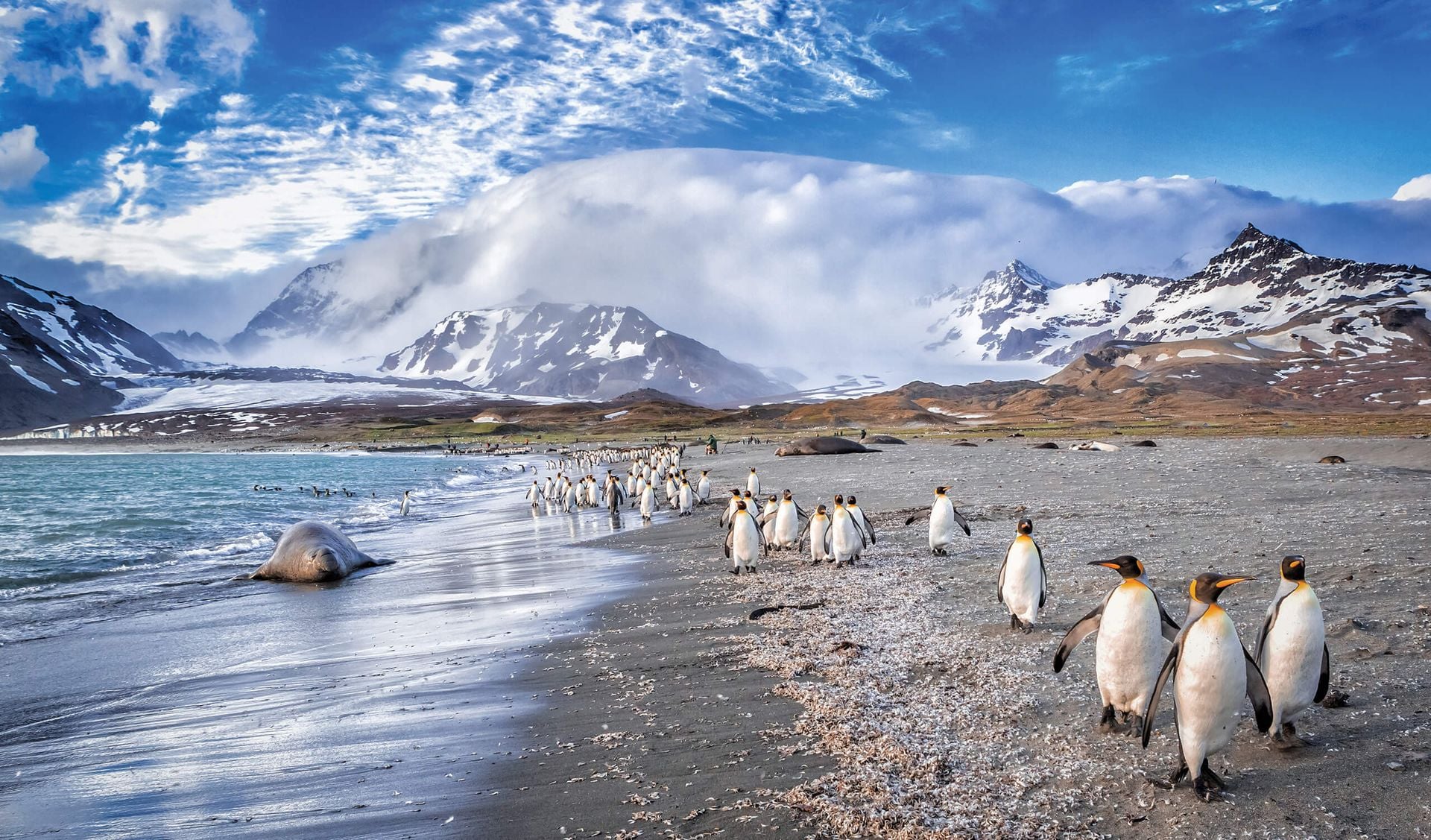
The seventh continent is the ultimate expedition — a place of colossal icebergs, glassy black-and-white seas, and wildlife with no fear of humans. There are no towns and no roads: you travel by small expedition ship, sailing from the tip of South America into a world few people ever see. Below are the best things to do and see in Antarctica, drawn from 30+ years of planning polar voyages — from Zodiac cruising among the ice to penguin rookeries a hundred thousand strong. Explore our Antarctica cruises.
A trip here is genuinely once-in-a-lifetime, and it needs planning — the season is short and ships book out far ahead. Here’s what awaits, and how it works.
Updated for the 2026-2027 Antarctica expedition season.
In Antarctica, there are a few things you can do that are optional on some cruise ships, like snowshoeing, kayaking, glamping overnight on the continent, helicopter rides, and doing the polar plunge (jumping into the ice-cold ocean!). You generally have to sign-up for these activities early as they have limited spots, so speak with your travel consultant while you are choosing a ship.
-Rebecca Deering
Antarctica Travel Expert

On some Antarctic cruises you’ll get the chance to sleep out for a night on the Antarctic continent in a tent or a bivouac bag. It’s not as cold as it might sound and is certainly a unique experience. Mostly you’ll hear complete silence, but you might catch the noise of whale blows or penguin calls. The sun hardly drops below the horizon during the peak summer months. You’ll return to the ship in the morning for a welcome hot breakfast!

Antarctica has an abundance of islands ideal for those who wish to explore. As they are the most popular destinations they are a great place to start planning our journey. On Antarctica Cruises Deception Island, South Shetland Island, Elephant Island, King George Island and more are built into your route. These islands provide visitors with sights of rare animals native to the continent. Each island hosts its own thriving wildlife, history, and various penguin or seal colonies, so let’s go island hopping!

On many cruises, the polar plunge is an activity that is offered, but only for the daring! Usually, the polar plunge is scheduled once during each voyage. This is where passengers can opt to jump into the freezing waters of Antarctica. To be safe, an expert expedition leader always monitors the conditions to deem whether a polar plunge is permitted.

Kayaking is one of the most popular activities in Antarctica. Imagine being able to reach down and touch the icy water and get up close to the grand ice sculptures. Guests often and see marine life like whales just inches away from you. Kayaking is also a great way to stay active while on an Antarctica vacation and some of the best whale watching on the planet. It’s the perfect way to see some of the highlights of this southernmost continent up close!

In March, whale watching is at its finest in Antarctica. You can enjoy this via kayak, or from the comforts of your expedition ship. And, there isn’t just one type of whale you can spot. In these icy waters swim Blue whales, Humpback whales, Minke whales, Killer whales, Sei whales, Southern right whales, and Sperm whales.

Just as there are a plethora of whales, there are quite a few species of penguins in Antarctica. One can spot the Emperor penguin, the Chinstrap penguin, the King Penguin, and more! The island you’re visiting will in some cases determine the type of penguin you see. For example, on the Falkland Islands, explorers will most likely be able to spot the Magellanic penguin or the Southern rockhopper penguin.

Aboard every cruise ship, there will be expert local guides and natural scientists who will give small informational lectures on the Antarctic water, terrain, and wildlife. These are usually given before travelers leave for daily excursions. This way, one can learn about the history of the area and then see it live.

As one of the closest cities to the seventh continent, many visitors stop through Ushuaia before their big adventure. Enjoy the world’s last modern conveniences, strolling through the quaint city streets, admiring views over the impressive, ice-filled bay, and appreciating local artwork along the waterfront. Feeling adventurous? Take a scuba diving tour through the Beagle Channel and search for marine life, including leopard seals and giant crabs.

While on a cruise to Antarctica, cross the world’s most dangerous waters, the Drake Passage, the route that in the 16th and 17th centuries were infamous to sailors. Today, the Passage is easily traversed by modern cruises, but the adventure remains a memorable one. During this journey, you will receive multiple educational seminars as well, discussing everything from geography to the flora and fauna that you’re about to explore.
Beyond the daily landings and Zodiac cruises, these are the iconic places and features that expedition voyages are built around.
Lemaire Channel is a very scenic channel between Kiev Peninsula and the mainland’s Graham Land and Booth Island. Here rest old abandoned bases like the British Base W on Detaille Island and the Southernmost Bar in the World at Vernadsky Station.

The glaciers of Antarctica can reach the size of entire countries. These majestic landmarks, such us the Ross Ice Shelf, not only provide spectacular views but are essential formations for the planet. As hotbeds for ecosystems and habitats of species from seals and walrus’ to the occasional Polar bear, glaciers are a crucial part of visiting Antarctica.

Part of the winter wonderland landscape of Antarctica are the grand icebergs. Icebergs are sculpted out of freshwater ice and can be part of a glacier. Throughout the months of the year, one can see icebergs floating in the seas around Antarctica. They may also change to different shades of blue making them an even more beautiful sight.

You’re rare to find more unique wildlife viewing than in Antarctica, with a plethora of species like the penguin, seals, sea elephants, sea birds and whales inhabiting the area. Any tour through Antarctica will be centered around the impressive nature all around. Visitors can walk on glaciers, get close to island sized icebergs, and even kayak in the freezing waters of Antarctica in order to get near the rare wildlife of the region.

Besides the obvious penguin and whale sight-seeing in Antarctica, there is a variety of birds that can be seen here as well. Look for the Wandering Albatross and Giant Petrels from the deck of the cruise ship. They might even try and hitch a ride with you by sitting atop the stern of the vessel.

Goudier Island, the location of Port Lockroy, was founded by the French after its discovery in 1904. Originally serving as a whaling port, the island transitioned into a research center post World War II, after the land was passed to the British. Though the research center is closed now, the port remains a significant educational center and tourist destination for the United Kingdom, hosting a museum in the old research center. Additionally, the southernmost post office in the world can be found here, providing visitors with the unique chance of mailing a letter back home all the way from Antarctica.

With flights connecting from Punta Arenas, Chile, for many King George Island serves as the first taste of life in Antarctica. The dramatic landscape of the island features three incredible fjords, various species of seals and penguins, and the picturesque Bellingshausen Station. The Bellingshausen Station, while popular for its quaint appearance, was founded by the Russians during their Soviet Antarctic expedition in the 1960s. Additionally, while exploring the dramatic, fog-capped shores, you may even spot old whale skeletons that have washed up over the years; absolutely eerie and exotic.

It’s the caldera of an active volcano and considered one of the safer ports in Antarctica because of its seclusion from the ice and winds. Today there are a few research sites but that’s not the main attraction for visitors. In the early 1900s, the whaling industry built structures here which were later taken over as research stations. Due to many volcanic eruptions over sixty years ago some research sites were abandoned and have been since. Today Deception island’s history is visible as old whale skeletons, abandoned buildings, and blackened volcanic sand. This is by far one of Antarctica’s most incredible sights.

Nearly all Antarctic voyages depart from Ushuaia, at the southern tip of Argentina, and cross the fabled Drake Passage — about two days each way — to reach the Antarctic Peninsula. For those short on time or wary of the Drake, “fly-cruise” options fly from Punta Arenas, Chile, across the passage to King George Island to join the ship, trading two sea days for a short flight. Expedition ships are small (typically 50–200 guests) so that everyone can go ashore. We arrange the voyage, the Ushuaia or Punta Arenas connections, and pre-cruise nights. See our Antarctica cruises.
The Antarctic season is short — roughly late October to March, the austral summer, the only window when the sea ice retreats enough for ships. Each part has its character: November brings pristine snow and courting penguins; December–January has the longest days and hatching chicks; February–March offers the best whale watching and receding ice. Ships sell out a year or more ahead, so book early.
Antarctica is more accessible than most people think — you don’t need to be an explorer or an athlete. If you can manage the steps into a Zodiac and walk on uneven, snowy ground, you can experience the landings; activities like kayaking, camping, and polar plunges are optional add-ons. The main considerations are the Drake Passage crossing (seasickness precautions help) and Antarctica’s strict environmental rules, which every operator follows to protect this pristine wilderness. See our Antarctica travel guide.
Antarctica is known for being the coldest, windiest, and most remote continent on Earth — a vast wilderness of ice and mountains, immense glaciers and tabular icebergs, and staggering concentrations of wildlife: penguins, seals, and whales that have never learned to fear people. It is the last true frontier of travel.
By expedition ship. Most voyages sail from Ushuaia, Argentina, crossing the Drake Passage (about two days each way) to the Antarctic Peninsula. A faster alternative is a "fly-cruise," flying from Punta Arenas, Chile, over the Drake to board the ship at King George Island. There are no scheduled flights or independent ways in — it's always an organized voyage. We arrange it end to end via our Antarctica cruises.
Antarctica is a premium, bucket-list journey. Expedition cruises start around $5,500 per person for shorter classic-peninsula voyages and rise well beyond that for longer itineraries, premium ships, fly-cruise options, and cabins with more space. As a benchmark from our own polar voyages, most travelers budget in the five figures once flights to Ushuaia are included. Ask us for options across the range.
The classic Antarctic Peninsula voyage runs about 10–12 days round-trip from Ushuaia, including the Drake Passage crossings and roughly 5–6 days in Antarctic waters. Fly-cruises can do it in as little as 8 days by skipping the sea crossing. Longer 18–23 day expeditions add South Georgia and the Falklands for spectacular wildlife.
No special experience is needed. If you can step into a Zodiac boat and walk on uneven, snowy terrain, you can enjoy the daily landings. More demanding activities — kayaking, camping, mountaineering, the polar plunge — are optional extras. The one thing to prepare for is the Drake Passage, where seasickness remedies are wise for those prone to it.
Extraordinary amounts of it, and remarkably close. Expect several penguin species (gentoo, chinstrap, and Adélie on the peninsula, with king penguins in South Georgia), Weddell, crabeater, and leopard seals, and whales — humpback, minke, and orca — especially later in the season. The animals have no fear of people, so encounters are intimate and unforgettable.


Our favorite South America tour ideas featuring the best destinations & activities designed to inspire…
Get your FREE South America Guide Now!

