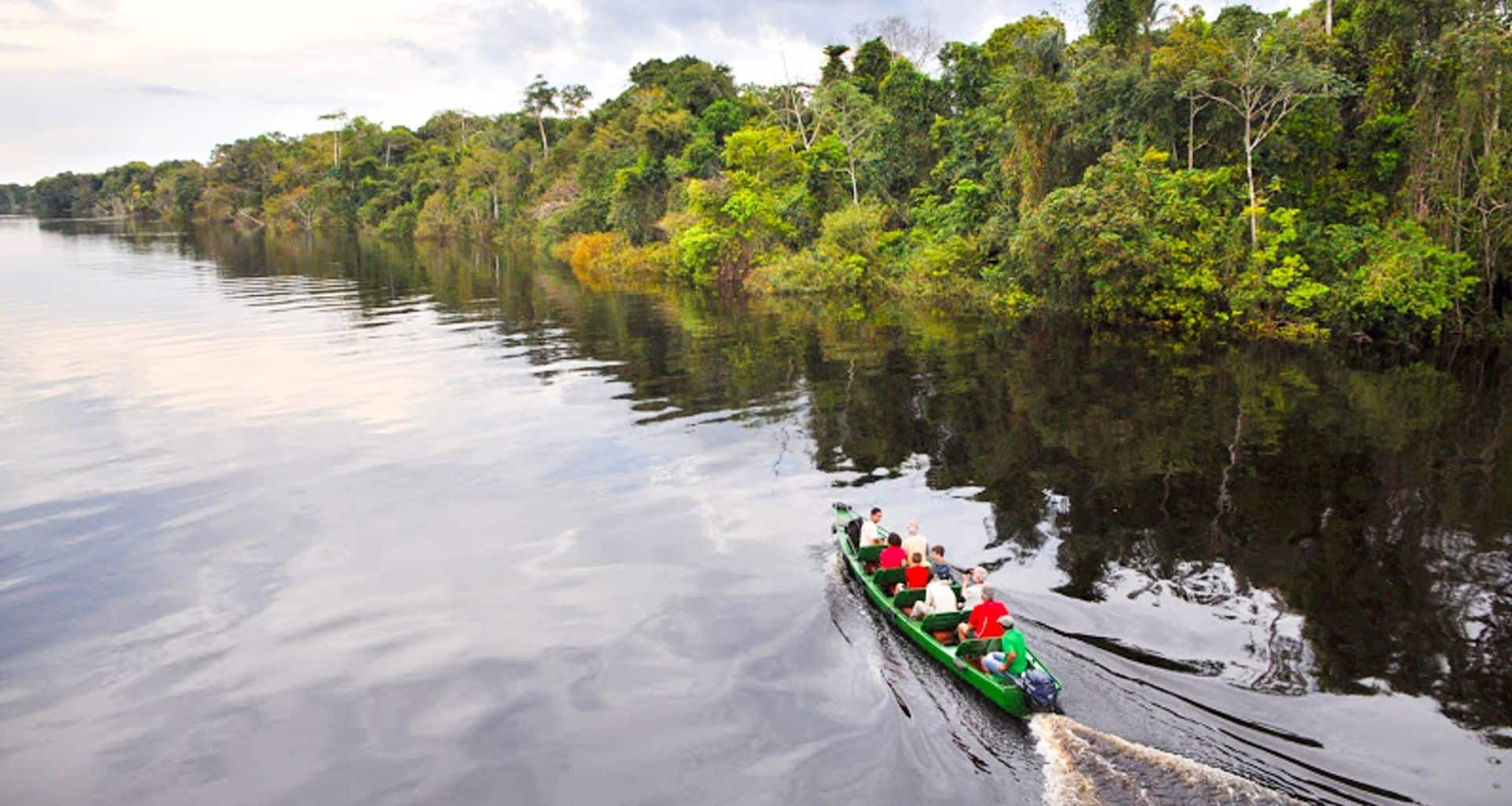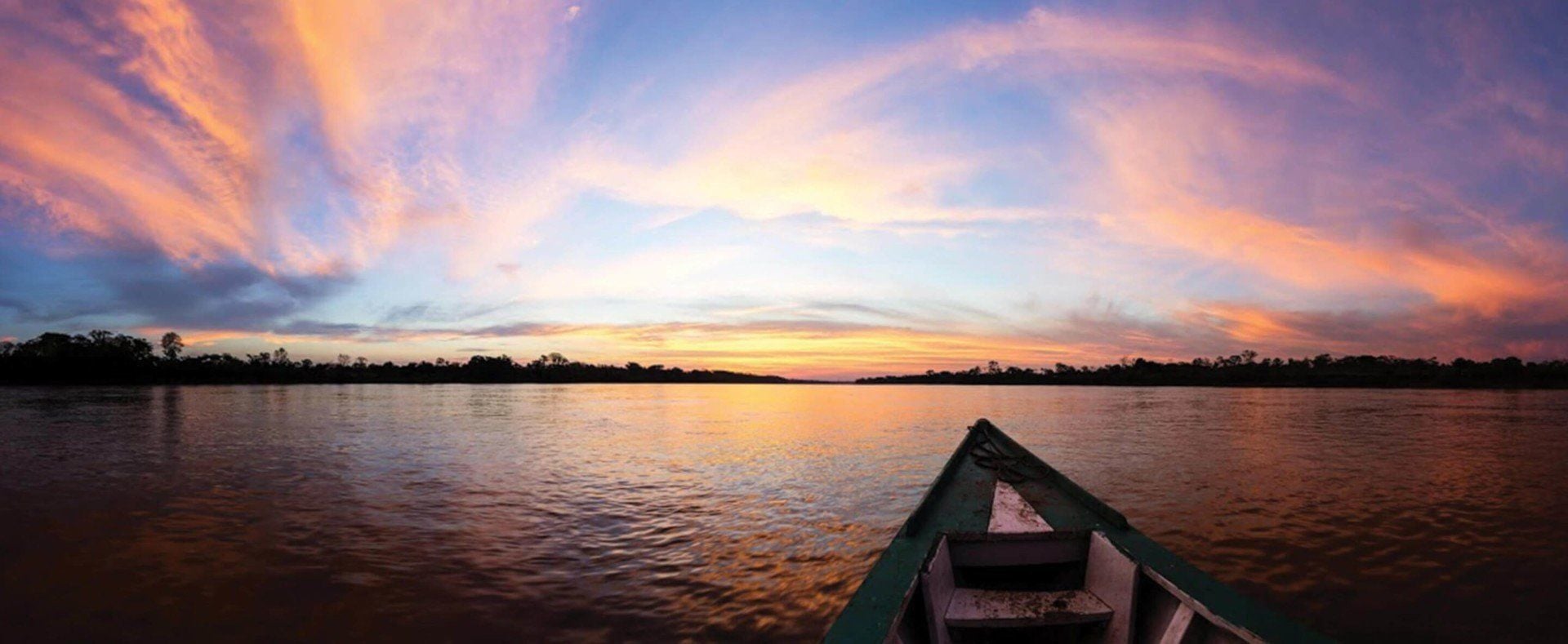
The Amazon rainforest has a hot, humid, tropical climate with rain in every month, and it is the rain that keeps the forest so green. In Manaus, on the Rio Negro in Brazil, the average temperature is about 81°F (27°C), and around 93 inches (2,362 mm) of rain falls on roughly 151 days a year.
It stays hot all 365 days of the year: in Manaus the monthly averages only move between 80°F and 83°F (27°C to 29°C), so there are no distinct winter and summer seasons. What changes is how much it rains and how high the rivers run.
These are the official 1991–2020 averages from Brazil’s weather service (INMET) in Manaus and Peru’s (SENAMHI) at its San Roque station in Iquitos, two river cities where many Amazon trips begin. Temperatures are in degrees Fahrenheit, Celsius in parentheses.
Manaus, Brazil
| Month | Avg high | Avg low | Rain | Rainy days |
|---|---|---|---|---|
| January | 88°F (31°C) | 74°F (24°C) | 12.0 in (306 mm) | 19 |
| February | 88°F (31°C) | 74°F (24°C) | 11.7 in (297 mm) | 18 |
| March | 88°F (31°C) | 75°F (24°C) | 12.6 in (321 mm) | 19 |
| April | 88°F (31°C) | 75°F (24°C) | 13.0 in (331 mm) | 18 |
| May | 89°F (32°C) | 75°F (24°C) | 9.2 in (233 mm) | 16 |
| June | 89°F (32°C) | 75°F (24°C) | 4.6 in (117 mm) | 10 |
| July | 91°F (33°C) | 75°F (24°C) | 2.6 in (67 mm) | 7 |
| August | 92°F (34°C) | 75°F (24°C) | 2.2 in (56 mm) | 6 |
| September | 93°F (34°C) | 76°F (25°C) | 3.1 in (79 mm) | 6 |
| October | 93°F (34°C) | 76°F (25°C) | 4.5 in (114 mm) | 8 |
| November | 91°F (33°C) | 76°F (24°C) | 7.4 in (188 mm) | 10 |
| December | 90°F (32°C) | 75°F (24°C) | 10.0 in (254 mm) | 15 |
| Year | 90°F (32°C) | 75°F (24°C) | 93.0 in (2,362 mm) | 151 |
Rainy days are days with at least 1 mm of precipitation.
Iquitos, Peru
| Month | Avg high | Avg low | Rain |
|---|---|---|---|
| January | 90°F (32°C) | 73°F (23°C) | 9.7 in (245 mm) |
| February | 90°F (32°C) | 73°F (23°C) | 9.1 in (232 mm) |
| March | 90°F (32°C) | 73°F (23°C) | 11.2 in (285 mm) |
| April | 89°F (32°C) | 73°F (23°C) | 10.0 in (255 mm) |
| May | 89°F (32°C) | 73°F (23°C) | 9.8 in (248 mm) |
| June | 88°F (31°C) | 72°F (22°C) | 6.4 in (163 mm) |
| July | 88°F (31°C) | 71°F (22°C) | 5.2 in (132 mm) |
| August | 90°F (32°C) | 71°F (22°C) | 6.3 in (159 mm) |
| September | 91°F (33°C) | 72°F (22°C) | 6.3 in (161 mm) |
| October | 91°F (33°C) | 73°F (23°C) | 7.8 in (198 mm) |
| November | 91°F (33°C) | 73°F (23°C) | 7.6 in (192 mm) |
| December | 90°F (32°C) | 73°F (23°C) | 9.3 in (237 mm) |
| Year | 90°F (32°C) | 72°F (22°C) | 98.7 in (2,506 mm) |
The Amazon certainly has a rainy season. In Manaus it runs from December to May, with at least 9.2 inches (233 mm) of rain every month, and peaks from January to April, when it rains on 18 or 19 days a month. From July to September the city turns much drier: August averages 2.2 inches (56 mm) on about 6 days, with more than twice the sunshine of February.
Iquitos, farther west in Peru, is wetter and more even. March is its wettest month at 11.2 inches (285 mm), and even July, the driest, gets 5.2 inches (132 mm). The old saying that the Amazon has no dry season holds for Iquitos, not for Manaus.
That difference is also the textbook answer on climate type. Under the Köppen classification, Iquitos has a tropical rainforest climate, because every month gets more than 60 mm (2.4 inches) of rain, while Manaus, with 56 mm in August, is classed as tropical monsoon.
For choosing a month, see our guide to the best time to visit the Amazon.
The rain sets the rivers, and the water level changes an Amazon trip more than the temperature does. The two cities run on different calendars.
Manaus (Rio Negro): the river floods from May to July, usually highest in June, and falls to its low point in October or November. On average it stands about 34 feet (10.5 m) higher at its peak than at its low.
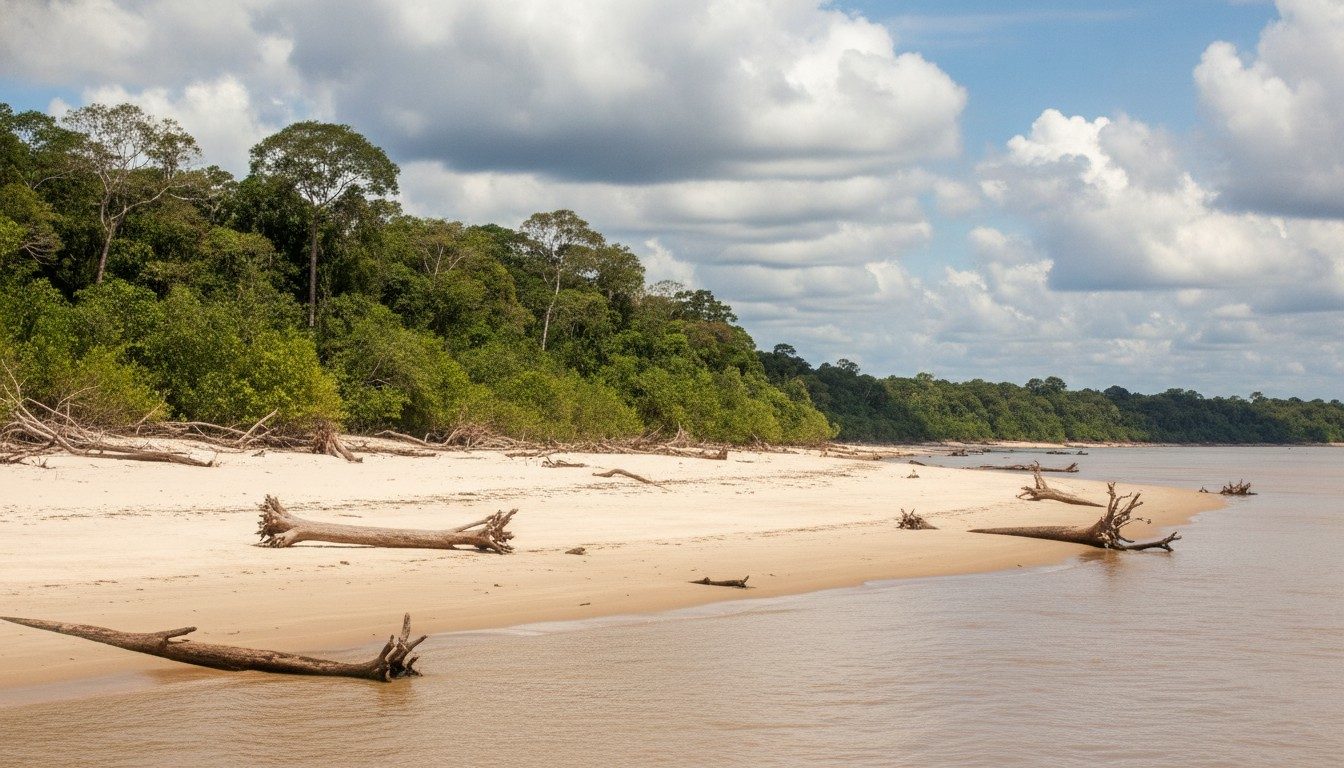
Iquitos (Amazon River): high water comes earlier, from March to May, and low water from about August to October, when sandy beaches appear along the banks. The river here can rise and fall by as much as 39 feet (12 m).
It is interesting to see how many homes along the rivers stand on stilts or float, so that families and their belongings stay safe through the seasonal flooding. In October 2024 the Rio Negro at Manaus fell to its lowest level in more than 120 years of records.
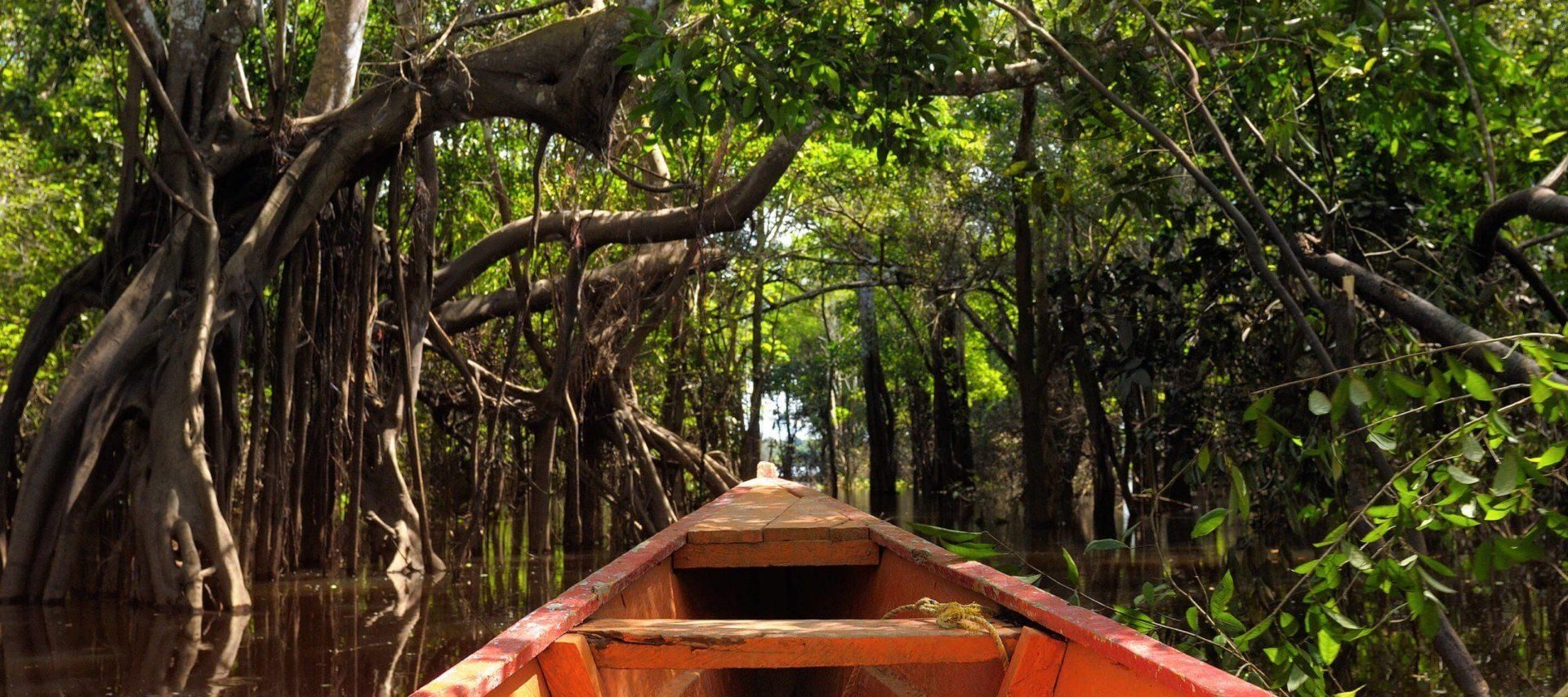
When the rivers spill over, the water carries you in among the trees. This is the season for canoeing through forest that stands on dry ground a few months later. At Uakari Lodge, floating bungalows in the Mamirauá Reserve, much of the exploring from May to July is done by canoe.
As the water drops, the land comes back: sandy beaches line the rivers, and there is more solid ground for walks from a jungle lodge.
In any season, a boat moves with the river, so an Amazon river cruise shows you different places, while a lodge lets you know one patch of forest well. The Remote Amazon Tour pairs the two. Get out on the water at first light, when the forest wakes up and the birds start flying again.
Tell us when you can travel, and our Destination Consultants will match the season to the right river on a custom Amazon trip, or browse our Amazon rainforest tours.
Expect heat. Daytime highs in Manaus average 88°F to 93°F (31°C to 34°C), and September and October each bring about 11 days of 95°F (35°C) or more. Nights stay warm, at 74°F to 76°F (24°C to 25°C) in Manaus and 71°F to 73°F (22°C to 23°C) in Iquitos.
The humidity is what you feel most. Manaus averages 81% relative humidity, and the dew point sits near 76°F (24°C) all year, so the air feels sticky even in the shade. Read our staying healthy guide before you go.
Rain is frequent, not constant. Our co-founder Juergen Keller puts it this way: even in the rainy season there are sunny breaks every day; it is just that when it rains, it rains very hard. Even in March, the Manaus month with the most rainy days, about 12 days stay dry, and a heavy day of 2 inches (50 mm) or more comes only about 8 times a year. All that water is what makes riverboat rides, canoeing and night safaris such a hit.
Cold is rare, but not unknown. Cold air from the south, called friaje, reaches the Peruvian Amazon 6 to 10 times a year, usually for 3 to 7 days, hitting the southern jungle hardest. Peru’s weather service says highs can drop from 95°F to 72°F (35°C to 22°C) and nights to around 52°F (11°C).
Pack for rain and heat at once. Waterproof gear matters most: rain boots, a rain jacket, and even a camera protector, plus light clothes that dry quickly and one warm layer for a cool night or a friaje. Our Amazon packing list covers the rest.