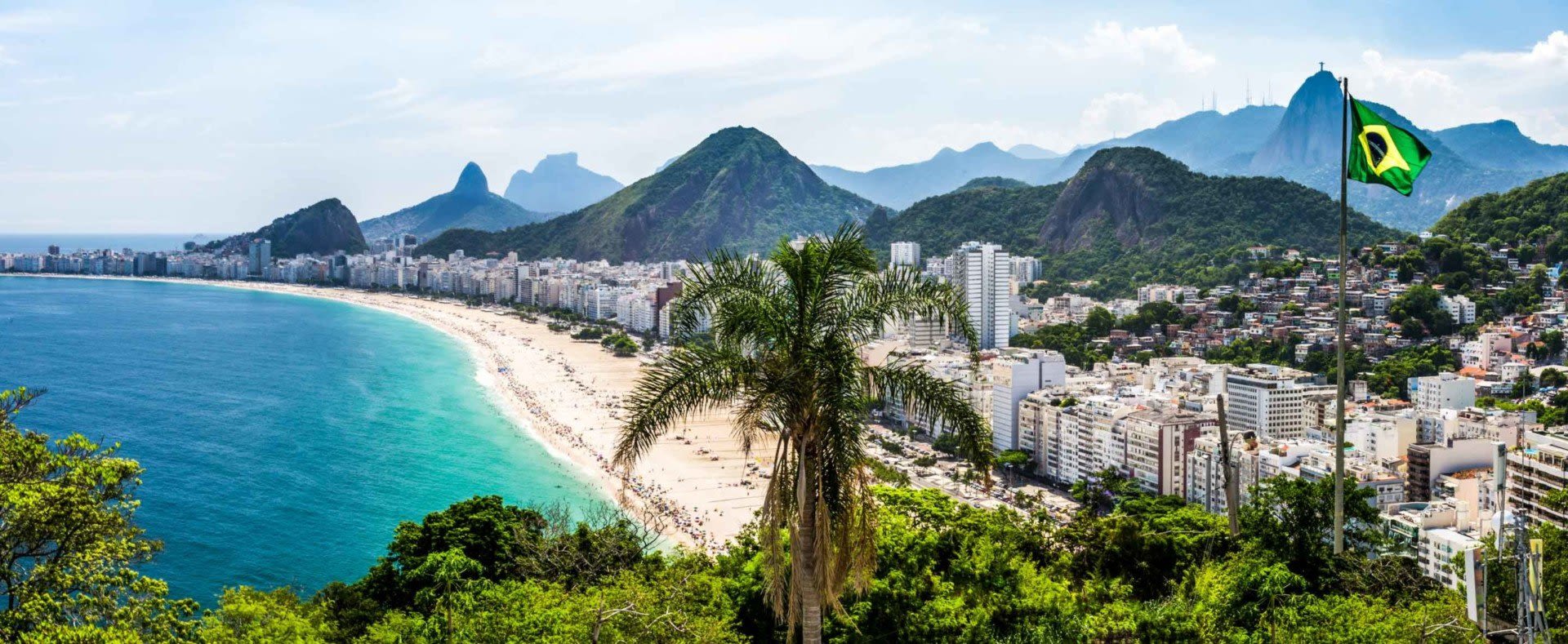
Here’s the first thing to know about Brazil: they don’t speak Spanish. Brazil is the only Portuguese-speaking country in South America — and, with more than 200 million speakers, it’s by far the largest Portuguese-speaking nation on Earth, dwarfing Portugal itself. A few words of Brazilian Portuguese go a long way here, and locals light up when a visitor gives it a try.
Brazilian Portuguese has drifted a fair way from the European version spoken in Lisbon — the vowels are more open, the rhythm is more musical, and plenty of everyday words differ. If you already speak some Spanish you’ll recognize a lot on the page, since the two are close cousins, but they sound quite different out loud, and the improvised mix travelers fall into even has a nickname: portunhol. The good news is that Brazilians are famously patient and warm with anyone making the effort.
Pronunciation holds a few friendly surprises. The nasal “ão” ending (as in São Paulo or obrigação) has no real English equivalent — think a hummed “ow” through your nose. And in Rio, locals known as cariocas turn their “s” sounds into a soft “sh,” so the greeting “boa noite” can come out sounding like “boa noish-te.”
Portuguese may be universal, but Brazil is woven through with other tongues. Indigenous languages of the Tupi family shaped the map itself — beach and place names like Ipanema, Itamaracá and Copacabana have Indigenous roots — and roughly 150 Indigenous languages are still spoken today, most of them in the Amazon, where Nheengatu survives as a living lingua franca. Waves of immigration left their own marks: you’ll hear German dialects in the southern towns around Blumenau, Italian (Talian) in the wine country of Rio Grande do Sul, and Japanese in São Paulo, home to the largest Japanese community outside Japan.
In hotels and the main tourist hubs you’ll find English spoken, and every one of our guides is English-speaking, with other languages available on request — so you’re never on your own with the language.
You don’t need to be fluent — a handful of phrases is plenty to break the ice and earn a smile. If you’d like to practice beforehand, free apps like Duolingo make it easy to pick up the basics on the plane, and a “Portuguese for Travelers” class or a program like Rosetta Stone works well too. Here are the essentials:
One thing travelers love about Portuguese: thank you comes in two flavors. Men say obrigado, women say obrigada — it matches the speaker, not the person being thanked.
Ready to try out your new vocabulary where it counts? Browse our Brazil tours — with English-speaking guides at your side, you can dive into the culture with total confidence.